It’s snowing here in Wisconsin as I write this blog post. Living in a northern climate can be tough because of our long winters. Long winters mean a short gardening season, which can be challenging if you love gardening as much as I do.
Right around this time of year I start to get a little impatient for spring to usher in the first days of getting my hands dirty in the soil. My fingernails have been far too clean for the last few months!
That’s why each year it feels like seed starting season arrives at the perfect time. I usually start my onions around the end of February and then work my way through my seed starting calendar over the next month.
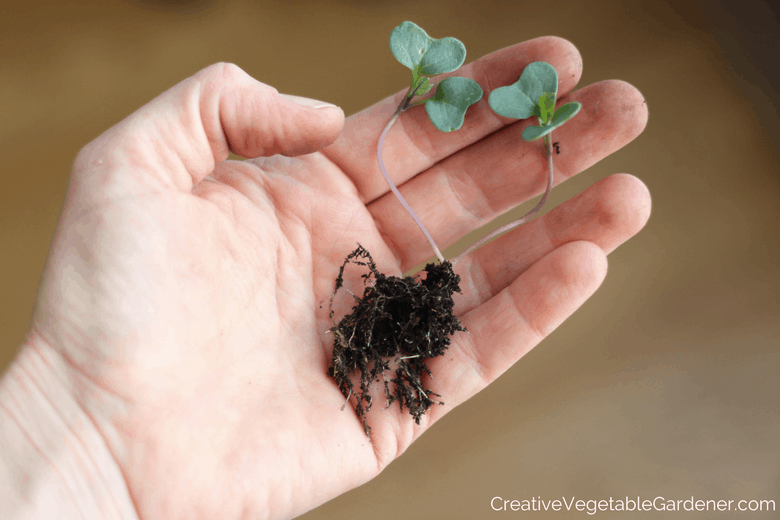
Little by little my seed starting rack fills up with tiny, baby plants that I can fuss over and check on every day. Seed starting signals to me that the gardening season has officially begun and that I’ll be back out planting these little green vegetables very soon.
I breath a big sigh of relief when I break out my seed starting supplies each February. Spring is coming, I just have to hold on for a few more weeks.
If you’re a new gardener who’s just embarking on the seed starting journey this year, or a seasoned seed starter who wants to pick up some new tips and techniques, this is the time to do it!
I’m sharing some of my favorite seed starting resources from around the internet so you can dig in and get motivated to add to your skills and improve your seed starting process.
If you’re a gardener who cares about your success and wants to grow lots of food in your garden this season, you probably have a sense that you should be doing some advanced planning so you’re prepared when the season hits.
But, when you hear everyone else talking about how they’re planning their gardens and ordering seeds, you feel a little confused because you’re not sure exactly where to start and what to do.
You’re not alone. Garden planning can feel overwhelming for gardeners who’ve never tried it before.
But, I’ve learned over the years that the most successful gardeners are the ones who give some thought to their gardens before the season begins.
Luckily, I’m a big proponent of keeping things as simple as possible when it comes to all things gardening, so “garden planning” to me doesn’t mean sitting for hours on end attempting to figure out exactly what I’m going to do each week of the season.
Instead, it’s about spending some time thinking about my goals for the year, getting clear on what new skills I might want to learn, experiments I’m hoping to try in my garden, and new varieties and vegetables I want to plant.
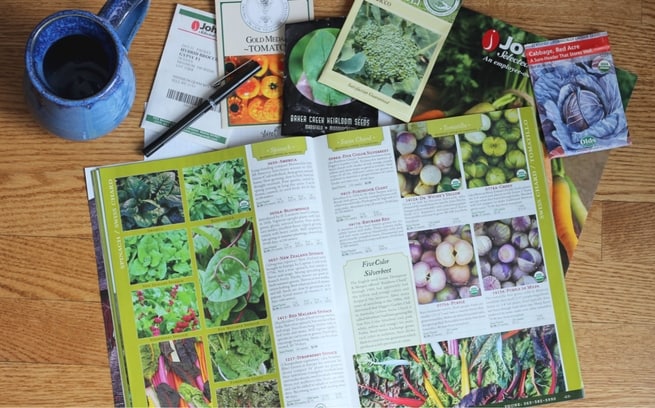
I aim to have this accomplished by mid-February most years so I can order my seeds and be ready to go when my seed starting schedule begins at the end of the month.
This timeline forces me to sit down and delve into some garden planning during January and early February. And even I, the person who teaches about how important it is to plan your garden, find it difficult to carve out the time with my busy speaking and teaching schedule at this time of year.
A case of the cobbler’s children having no shoes? Possibly. This garden educator sometimes has trouble making time for her own garden.
If this sounds like you, too, I’m hoping to help you jump-start your own process with this roundup of vegetable garden planning resources. Block out a few hours of time in the coming weeks to really delve into and savor the beginning of the gardening season by engaging in some light and fun planning.
Two things happened last week that gave me the idea for this blog post:
#1: As part of the pre-order for mySmart Start Garden Planner I offered a special bonus that included a list of all of the varieties I’m growing this year. On the list are 29 vegetables and 79 total varieties.
One of the gardeners who received this list posted on my Facebook page, “I just looked over your list of seed varieties for this year…Wow!!! I’m curious, how big is your garden space?”
#2: I was asked to look over a new gardener’s plan for the upcoming year. She mapped out her new garden space with everything she was going to plant. It was beautiful and organized and I think she’s going to be a very successful gardener.
And, I did find one potential problem with her plan. Her plan included planting eight tomatoes, nine trellises of pole beans, and fourteen cucumbers, all of the same one or two varieties. I advised her why planting more variety would be a much better idea.
Both of these this things led to the realization that there’s a big question hanging out there in a lot of your minds – how many varieties should you plant?
And this is exactly why I love this community of gardeners. You inspire me to look at gardening in new and fresh ways. And you help me become aware of the ways I think about gardening as an experienced gardener, ways that might not be natural for newer gardeners.
To a certain extent, gardening feels like a waiting game. Once we get our plants and seeds into the ground, we immediately start looking forward to the day when we can harvest the food.
But vegetables vary widely in the number of days they need to grow until we can harvest them for dinner.
How long do vegetables take to grow?
Radishes are ready to eat in as little as 21 days, while Brussels Sprouts need as long as 110 days to grow to a harvestable size. That’s a HUGE difference!
Part of strategically deciding what you want to grow in your garden is knowing the time investment required for each vegetable.
If you want to extend your harvest into as many months of the garden season as possible, you’ll want to plant vegetables that take various lengths of time to deliver their harvest.
For example, in spring, if you plant a bunch of vegetables that take over 100 days to deliver a harvest (leeks, pumpkins, Brussels sprouts), you’ll have a garden growing through the entire summer, but you won’t be able to harvest any food for your dinner table until fall.
That’s no fun!
On the opposite end of the spectrum, if you only plant short-season vegetables in your garden in spring (radishes, lettuce, spinach), you’ll get a bumper crop in late spring and early summer, but not much food for the rest of the season (unless you replant in those spaces).
In this blog post, you’ll learn how long it takes to grow different vegetables so you can make an informed decision when choosing which vegetables to devote space to in your yard.
You might even decide some vegetables just aren’t worth it!
During the winter when passionate gardeners like us can’t be out in our gardens, what activities are good stand-ins? Planning our gardens, reading books about gardening, starting seeds, and listening to other people talk about gardening on favorite podcasts.
Do you sense a theme here? It’s all about how to immerse ourselves in our favorite hobby without actually being in the garden.
If you’re feeling blue about the big empty hole your garden leaves in your life in winter, don’t fret, you can get your needed daily or weekly dose of gardening through other sources!
Personally, my sanity depends upon getting my minimum daily requirement of gardening all year round.
(I completely understand if the term gardening addict just jumped into your mind. I never said I wasn’t crazy about gardening, did I?)
But, there are certain situations in which it’s difficult to read a book – taking a walk, painting your guest room, working on an art project, cooking dinner, driving the car…
Luckily, that’s where podcasts come in. If you haven’t jumped on the podcast listening bandwagon yet, it’s time.
They’re easy to access, especially if you have a smartphone, and there are hundreds of thousands of podcasts out there on every subject imaginable, including gardening.
Over the years I’ve researched and listened to many gardening podcasts, and I’ve even been a guest on some of them. Here are my favorite gardening podcasts to get you started listening and exploring!
I saw a post on social media this week from a large plant grower who wrote, “You might not be thinking about gardening right now, but we’re busy growing millions of plants for next spring.”
And I thought to myself, “I think about my garden every single day of the entire year. Doesn’t everyone?”
For many of us, gardening isn’t just a hobby, it’s a lifestyle. It influences every aspect of our lives, from the food we eat and cook with, to the books, magazines and websites we read, to how we spend our free time.
The deeper we delve into this craft of ours the more we realize how much there is to learn. The details of gardening are what breathe life into this pursuit and keep it interesting, engaging…and even addicting.
Over the last 11 months, hundreds of thousands of passionate gardeners have visited my website. And you’re one of these amazing people! I’m so grateful that you’re a part of my community and that you love gardening as much as I do.
Together, we’re honing our skills and diving deeper into our shared craft. This website, my teaching, and my writing will always be about educating and encouraging you to get the most from your garden — the most joy, food, beauty, peace, and connection.
Thank you for being a part of my gardening journey this year, and sharing yours with me.
Since this blog post is all about you (and how awesome you are!), I thought I’d share the most popular organic gardening tips of this year as determined by lovely readers like you.
One of the most difficult parts of winter for me is the total lack of color outside in my yard. My vegetable and perennial gardens are huge pops of color that bring me a deep joy all season long. When the gray days of winter set in I start to feel visually depressed.
This fall, when I was bringing some of my houseplants back inside I started to think about how I could recreate the feeling of a garden inside my house. In the past, we had all of our houseplants spread throughout our house in various rooms. One day while I was puttering around I had a flash of inspiration – I wanted to create a jungle of houseplants around my dining room table!
Our dining and living rooms are one big area and it’s where we spend a lot of time hanging out near the woodstove, reading, entertaining friends, and watching movies. We also sit down at our table every night and eat dinner together.
The holiday season can be a tough time of year for those of us who make nutritious eating and cooking a top priority. It can feel stressful to try to fit our normal healthy habits into our lives as the holiday craziness starts to build.
I even heard someone say on the radio this week, “This is the least amount I’ll weigh until sometime in January.”
It can be a challenge not to let things slip during the many work celebrations, holiday gatherings, and cookie exchanges of November and December.
Unfortunately for me, if I stray too far from my normal eating routine I end up with a headache, stomachache, or various other physical reminders that my body doesn’t function well with too much sugar, dairy, or heavy foods.
Over the years I’ve come up with some strategies for healthy holiday eating that help me avoid the worst of what the holiday season brings.
Because when I feel good, I can focus on enjoying my favorite parts of the season – connecting with friends and family, spending time in nature, a blanket of snow on my garden, and of course, a few chocolate chip cookies here and there.
Here are my favorite healthy holiday eating tips to help support you in maintaining your nutrition and physical well-being during this fun and festive season.
Kale is one of those controversial vegetables that elicits many different responses from people.
Some people think its proper place is as a garnish on the buffet table and others walk around with their Eat More Kale t-shirts like religious devotees.
Which camp do you fall into? Or are you somewhere in the middle?
It’s no mystery where I fall. I usually grow 15 or more kale plants in my garden every season.
Kale is officially a trendy vegetable, but it’s possible you find it puzzling that it’s inspired such adoration recently. And if you’ve planted more than a few plants you probably have more kale coming out of your garden then you know what to do with.
That’s been my story.
Until I was introduced to the magic of massaged kale salads.
It’s truly been a game changer for our relationship – me and kale. I no longer get sick of it or feel guilty that I’m letting it go to waste in my garden.
In fact, for the first time ever, this year I said to my husband, Mark, “I definitely need to plant more than 15 kale plants next year. I felt like we had to ration kale this season.” What?!
If you’ve been wondering how to use all of the kale you’ve been growing, or just want to include more kale in your diet but don’t know how, the miracle of massaged kale salads might be just what you need.
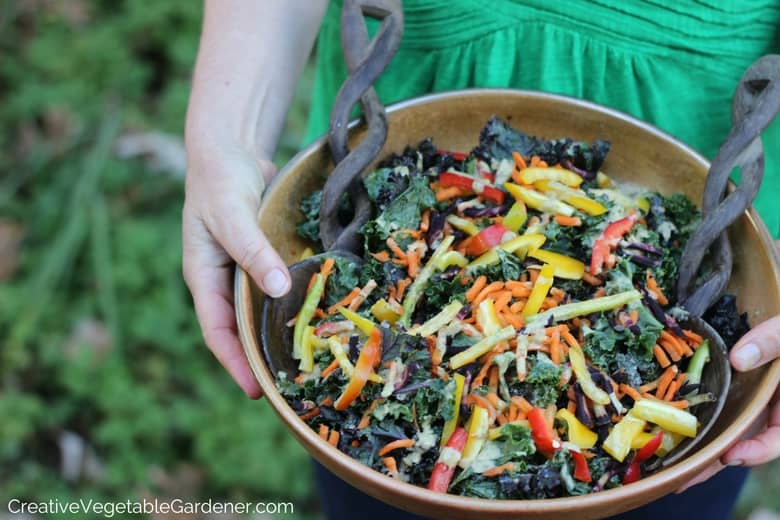
Massaging the kale completely transforms it from a waxy garnish into a savory, smooth and filling salad that deserves to be center stage at the dinner table.
There’s nothing quite like pulling out a container of your own tomatoes to throw into a recipe in the middle of winter. Jarred and canned tomato sauce from the supermarket can’t hold a candle to the bursting flavor of tomatoes grown in your own garden and preserved for use in delicious meals in the off-season.
I’ve done the taste test! Mine wins every time.
But, you might think preserving tomatoes means boiling hot liquid, marathon canning sessions, and a large kitchen cleanup.
Sure, you can preserve your tomatoes this way, but you don’t have to.
When I lived on a farm many years ago I learned the laborious process of boil canning tomatoes. We spent many weeks during the summer sweating in the outdoor kitchen while we canned jars and jars of tomatoes from the large garden.
It was miserably hot work.
And for a few years after leaving the farm I just accepted that this is how you went about preserving tomatoes.
Until one day, when I stopped and realized how much work this was. Each summer I would dread my tomato canning sessions and push them off as long as possible. “There’s got to be another way.” I thought to myself.
And I have good news — there is a better way for preserving tomatoes!
There are plenty of food storage methods to stock your pantry for winter that don’t include canning. Here are 5 quick and easy favorites.
For many gardeners, late summer and early fall signals the peak of the harvest season.
Although filling up baskets and bowls full of vegetables from your garden can feel exhilarating, it can also be overwhelming and stressful.
If you find yourself giving away or even worse, composting, extra produce, consider trying your hand at some simple food storage methods this season.
Contrary to popular belief, food preserving doesn’t have to be difficult, take up a lot of time, or require lots of fancy equipment.
In fact, I’m a big advocate super easy food preserving. (I even wrote a whole book about it.)
Instead of spending a full day in a sweltering kitchen, easy preserving means using the simplest and quickest food storage methods for putting each vegetable, fruit and herb away for use in delicious meals all season long.
Let’s take a look at the options!
5 Easy Food Storage Methods
I call myself a lazy food preserver, if you believe in such a thing. I reluctantly can 1-2 batches of salsa each summer because it’s difficult to imagine doing without it.
The rest of my time is primarily focused on crops I can store quickly and easily. I like to put food away, but I don’t want to spend my whole summer food preserving.
The time I invest is worth it because I live in an area with an extremely long and cold winter (Wisconsin) and a short gardening season. Even so, I rarely purchase food from the grocery store and draw from my pantry instead.
It’s a wonderful feeling of accomplishment when I eat a meal on a snowy winter day consisting of food I grew myself and stored in my pantry.
Let’s get you started on this path as well!
Here are my top 5 favorite easy food storage methods.
#1: Fresh Storage
Whenever possible I like to store my vegetables in their natural state. This requires the least amount of work and preparation.
It doesn’t get any easier than this.
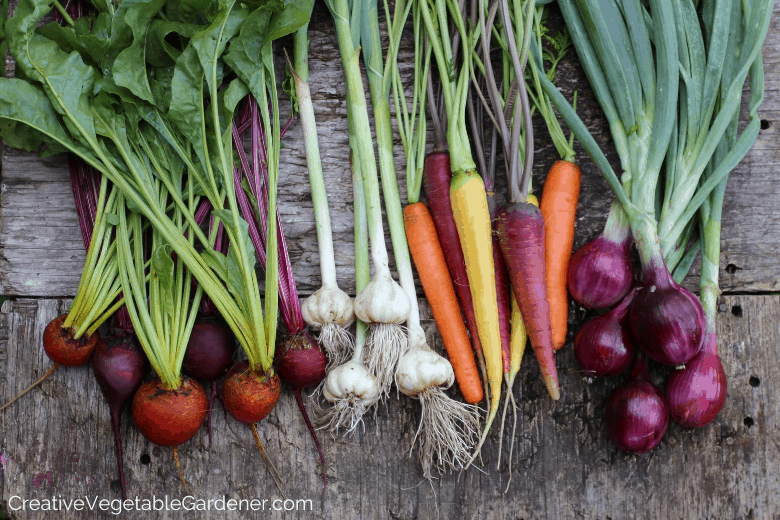
Each year I grow 400-500 onions and 220 garlic. After getting cured in my garage they all get packed in boxes and crates and stored in my basement. Both of these vegetables will last 6-12 months in storage depending on where and how you store them.
Since most of the dishes we cook in our house start with garlic and onions sautéing in a pan, it’s super convenient to just run downstairs to get what we need to cook dinner.
There aren’t a ton of vegetables you can store fresh, but garlic and onions are two great ones to start with.
Read more about how to grow, harvest, and cure your onions and garlic for long-term storage.
Using your fridge is another way to store vegetables without processing.
Each season I save room in my garden and grow a big crop of fall beets and carrots.
I harvest them straight from my garden into early winter, and just before we get a deep freeze (usually in December) I’ll harvest whatever is left.
I remove the tops, keep the soil on the roots, and load them into plastic bags. The bags get stored in the bottom of my fridge and we eat our own carrots and beets all winter long.
Read more about which vegetables to store in your fridge:
There are many vegetables that can be easily frozen for long term storage. Some need to be blanched or steamed first, and some can be frozen raw.
If you’re going to be doing a lot of freezing I recommend investing in a chest freezer. Because it doesn’t have the natural defrost cycle of a kitchen freezer, the food quality remains high for about a year.
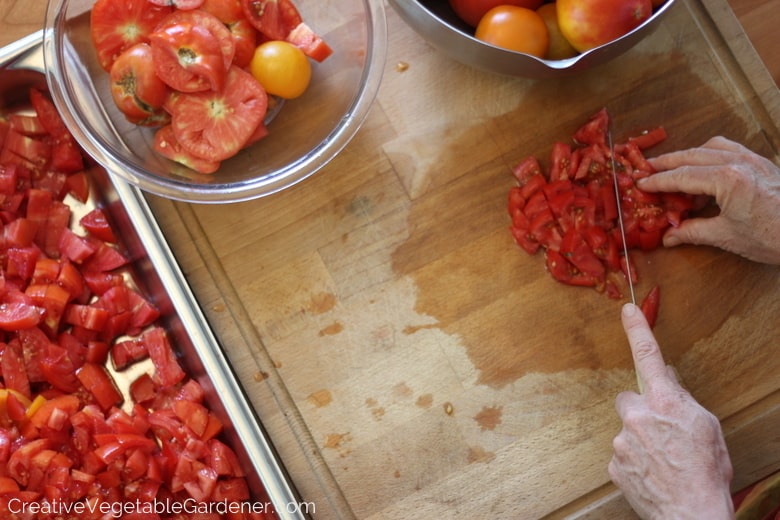
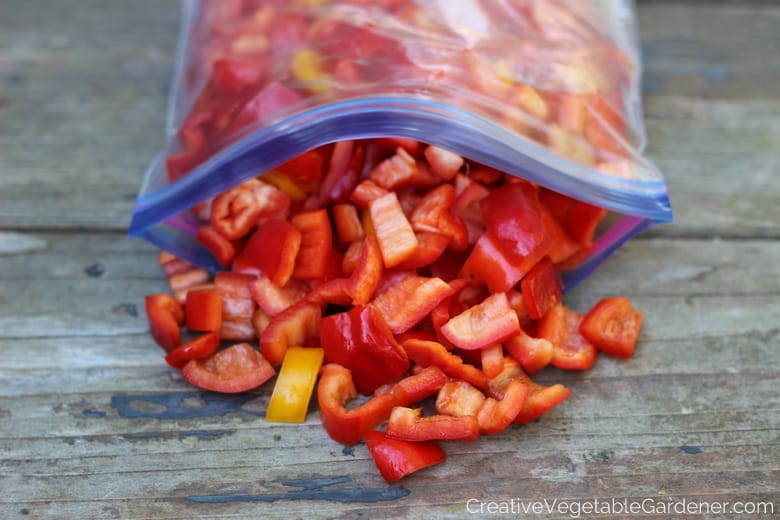
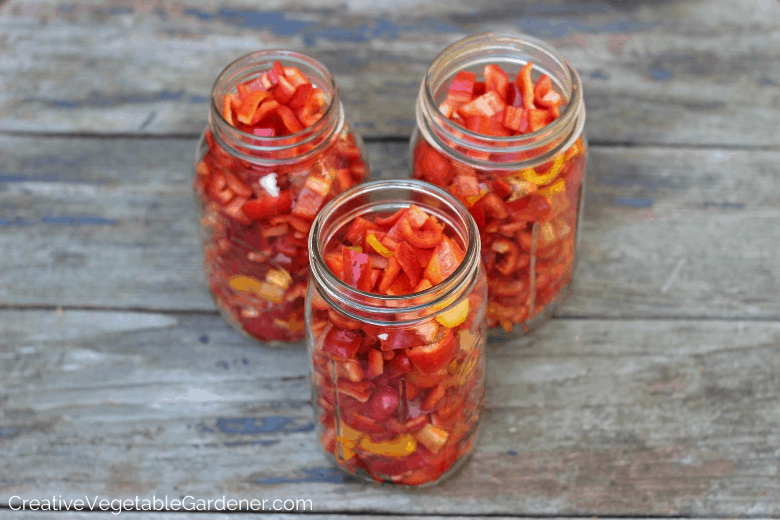
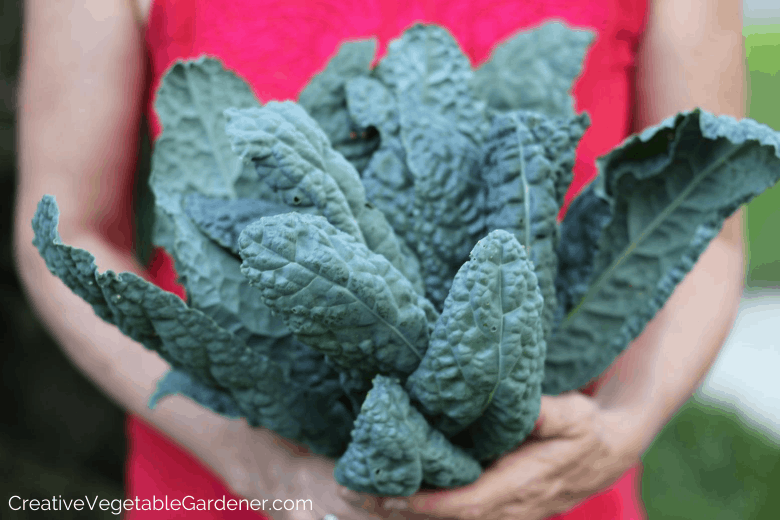
Some of my favorite vegetables to freeze are kale, red peppers, and tomatoes. Both can be chopped fresh from the garden and put directly into freezer bags or containers. When you’re ready to use them in a recipe you can just grab a handful and throw it directly into the pan.
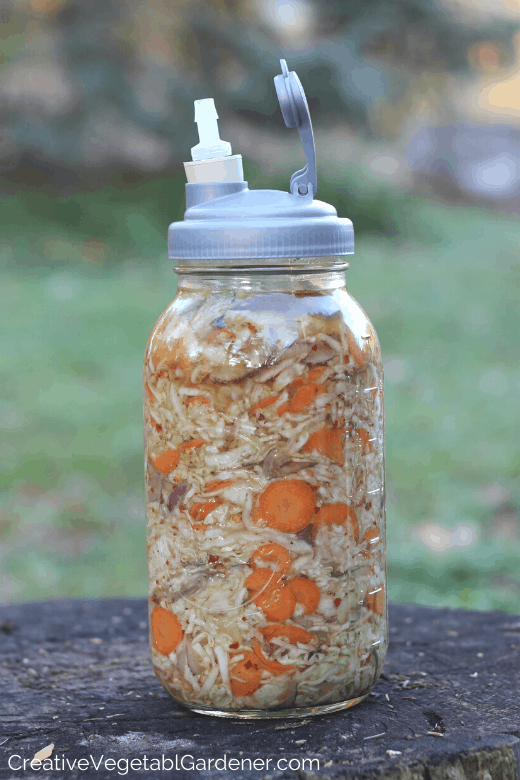
Fermenting vegetables is a food storage method I’ve added to my tool kit in the last several years. Once you get the hang of it and understand the process, it’s easily repeatable with lots of different vegetables.
As an added bonus, fermented foods can be stored in your fridge for up to a year and they retain much more of the nutrients than canning (and add beneficial bacteria that’s good for your gut).
I use cabbage, carrots and onions to make curtido (a spicy version of sauerkraut), pickling cucumbers to make sour pickles, and Napa cabbage and daikon radishes for Kimchi.
I’m always surprised how little work and time is required to make a half gallon jar of fermented food. And if you already buy ferments from the grocery store, you know they can be very expensive. You’ll save a ton of money by making your own.
In these two articles I share my 5 favorite recipes and tips for beginners:
In our house we have a saying, “It’s all about the sauce.” The way we tend to eat, especially in winter, is centered around making one bowl recipes that feature a base like rice, noodles or quinoa, a bunch of roasted or sautéed seasonal vegetables (whatever is coming out of the garden), and a protein. And on top goes (you guessed it!) a special sauce!
Many of these sauces feature herbs, which can be very expensive to purchase during the winter. Luckily, they’re super easy to grow and it’s easy to have more than you can possibly eat.
That means you can stockpile a freezer full of favorite sauces during summer and fall when the ingredients are abundant. Then in the winter, when it’s time to cook dinner, you can simply thaw out a jar and throw it on top of a dish. Super easy!
Explore some of my favorite sauces in these posts:
Because I like to keep things simple, canning is my least favorite way to preserve food. It’s time consuming, messy, and you need to follow an exact process to keep it safe.
We eat a lot of salsa in our house, so we do have one canning session each season and make as much salsa as humanly possible.
Some people love canning, but in my opinion there are much easier ways to preserve most vegetables.
Which Food Storage Method Should You Start With?
My advice (as with all things gardening related) is to keep it simple. Take a look at the meals you eat and the groceries you buy on a weekly basis and come up with a list of five things you’d like to have as ingredients for cooking during your garden’s off season.
Then, take a look through this article and decide which of the food storage methods sound easy and fun to you. What are you excited to try this season?
Start with that.
Once you get a taste of having a pantry full of food you can use in your favorite recipes all winter long you’ll start to get addicted to easy food preserving. I promise!
Additional Resources for Exploring Food Storage Methods
BOOK:
Preserving some of your excess produce is the best way to make your garden harvests last all year. And, preserving doesn’t have to be difficult or take up a lot of time.
My book, Super Easy Food Preserving, features the simplest and quickest way to preserve each fruit, vegetable, and herb. Read more about it here.
MASTERCLASS:This winter, imagine grabbing all the ingredients you need for a meal right from your pantry without having to go to the grocery store! With a few simple techniques you can continue to enjoy food grown in your own garden (or purchased from the farmers market) throughout the long, cold months of winter.
This class will teach you how to make every harvest last longer by quickly and easily preserving vegetables at the height of their season. You’ll love the feeling of sitting down to a meal and knowing a large part of it came from your garden!
In the span of one Saturday morning trip to the farmers market I had a sudden realization that completely changed the way I look at food preserving.
I was trudging around loaded down with vegetables (I go there to buy things I don’t grow – corn, melons, blueberries) when I started to notice the great bulk deals all around me.
An overflowing bucket of pickling cucumbers for $10. Tomatoes for $1/lb. Huge bags of broccoli for $2.
“Look at all of these great prices!” I thought to myself. “I should buy some of these vegetables for preserving.”
I should buy some of these vegetables for preserving…
That thought hit me like a bolt of lightning.
It was quickly followed by a brand new realization – I don’t have to grow everything I preserve. Whoa!