This week in my new online workshop, Design + Install Your Own Garden, we are talking about the building blocks of the garden – beds, paths, fences and gates. The participants are getting ready to begin transferring their garden visions into hand drawn garden designs. They are making decisions about how they will feature these garden elements in those designs.
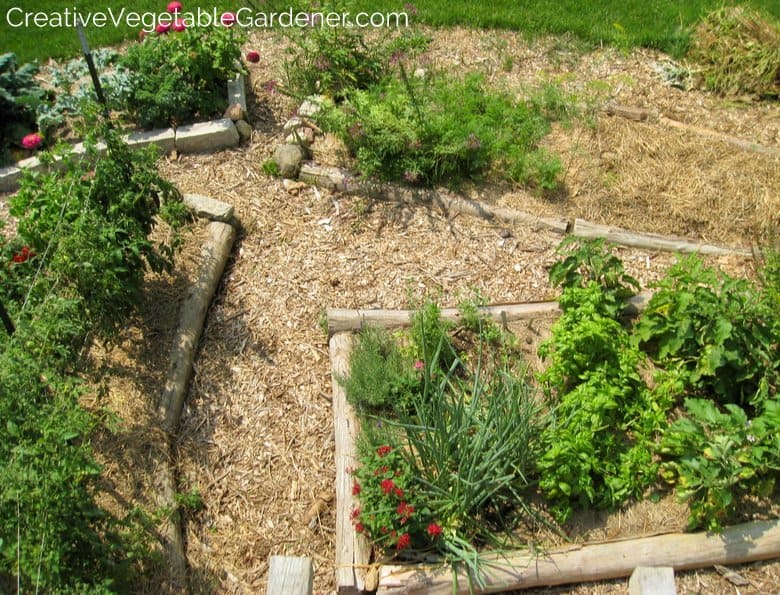
I don’t recommend keeping your paths as bare soil. Weeds will definitely grow there – that’s their job! And spending time weeding paths is a waste of time. My favorite material for paths in my own garden is woodchips. This could be because I am married to an arborist who owns his own tree care company. I can get all the woodchips my little gardening heart desires.
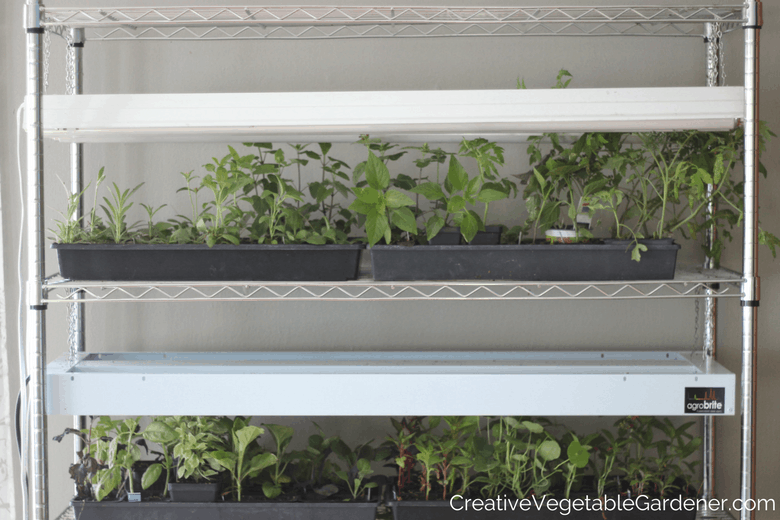
In this post, I’ll show you how easy it can be to build your own DIY grow lights so you can master the art of growing organic vegetable plants at home. I’ll share lots of photos of my home set up and share links to the short list of materials you’ll need to get started.
After you’ve been growing your own food for a while you might start to wonder about starting seeds at home for your garden. It’s a ritual many gardeners eagerly look forward to every winter.
Growing your own vegetable plants is a fun way to get a jump on the gardening season and start getting your hands dirty before you’re able to get out into your yard.
A huge world of interesting and unique vegetable varieties are available to gardeners who start their owns seeds, so you can experiment with lots of unusual vegetables you probably can’t find at your local farmers market or nursery.
And once you learn the process of seed starting, it’s easily repeatable year after year.
If you love the excitement of starting seeds but feel like you have mixed success from year to year, you might be making some of these common mistakes of seed starting.
The number one goal of starting your own plants is to produce healthy and vigorous seedlings that will survive the trials and tribulations of the outdoors once they’re planted in the garden.
Focusing on a few of the most important factors that go into growing great plants will help you improve your seed starting success by leaps and bounds.
And that means it will be a lot more fun – which is one of the main reasons to start your own seeds!
At the end of this post, you can also watch a video where I expand a bit on some of these mistakes.
My favorite hike in the Cochamo Valley. Straight up for 3.5 hours!
The main reason we picked Chile for this year’s vacation was its national parks and stunning natural beauty. Over our many years of travel we’ve realized we are happiest when hiking and exploring the natural world are part of our experience.
Chile has an incredible park system distributed throughout the country which highlights the diverse ecosystems that exist there. We spent a lot of time in and near mountains, rivers, waterfalls, forests and lakes. Mark said he thought it was the most hikes we ever took in one month. And most of them were straight up – a bit much sometimes for flatlanders like us!
The Andes is the longest mountain range in the world and it borders Chile to the east. It seemed that everywhere we looked the Andes were there in the background– huge volcanoes, snow-capped peaks and undulating ranges as far as the eye could see.
Here are some of my favorite photos from our adventures.
One of our favorite hikes in Chile. Short and snowy mountain tops!
Right before we leave for our winter vacation each year there are a few instances where I second guess our decision to go away for so long. I’m so wrapped up in my daily life and the minutiae that make up those moments that I have a hard time wrapping my head around taking a break from it all.
I sometimes even panic a bit, thinking that it’s crazy to try to just drop everything for six weeks. There’s just too much to do.
But, predictably, during the first week of vacation, I usually laugh at myself and think, “Did I really think that we shouldn’t go away this year? Am I crazy? We should go away every year. This is so awesome!”
Every fall, I spend a few full days in what I call “garden deconstruction” mode. I rip out the dead and dying plants, clean and store the tools, and organize buckets, trellises and fences. I mindfully put the garden to sleep and focus on setting a low-maintenance foundation for the following spring. I make mental notes about changes and additions: a few less kale plants, two plantings of basil, definitely repeat the red zinnias paired with the yellow rudbeckia.
This year, as I find myself taking those notes for next year I catch myself… There won’t be a next year for me in this garden.
Our house went up for sale two months ago—“a gardener’s paradise,” I wrote in the listing. And it has been my own private slice of paradise, my little laboratory of garden experiments and trial and error. This garden has been the first space that has been all my own—not a garden in a yard owned by someone else, not a plot in a community garden. My garden. My humble little corner of this big, wide world.
It’s been a place to plunge my two hands deep in the soil and connect with the mysteries and miracles of the natural world. My relationship with this garden has been more intimate than with other gardens I’ve tended. I (and my partner-in-crime, Mr. Creative Vegetable Gardener) have shaped and cajoled her from a sad scrap of dirt into the beauty of riotous color and texture she is today.
Many people have been asking me, “But how can you leave your garden?” I ask myself this sometimes as well.
But then I realize it’s not my garden. It’s a garden—a patch of earth that I’ve had the blessing and the pleasure to tend these past seven years. I don’t own it, and I certainly don’t have much control over it. So mostly I just joke, “Well, my work here is done. Time to move on.”
And there is a lot of truth in that statement. I am a creator. I know this about myself. I love to brainstorm and design and experiment and perfect. And when the project (garden, mosaic, program) arrives at a point of stability and function, I start to feel that old familiar stirring inside of me. I hear the whispers of other adventures out there waiting for me.
There are always new projects to conceive and more gardens to create.
So in these days of waning light and warmth I am making a sacrament of cleaning out my garden. Each plant pulled is a farewell, and every hay bale spread evokes a feeling of deep gratitude. I will miss the old girl, I will, but those whispers are getting louder and I am having exciting visions of the new garden.
Having a beautiful vegetable garden not only feeds my belly but also my soul. I never get tired of looking at my garden from different angles. My house backs up to a community garden where I have two plots in addition to my backyard garden. On my walks back from working in my plots I get to view my backyard vegetable garden from afar as I approach it. When I step out my back door I am right in the garden, so I also see it from a closer, opposite angle than when I am walking from the community garden. Other times, as I am kneeling or crouching down in my garden weeding or planting I look around and I am surrounded by the tall plants and flowers and I feel that I am within the garden.
The rolling hills of NE Missouri look a lot like Wisconsin in this photo.
I was raised a city girl. My family, and everyone else we knew, lived in a row home in an urban area of Philadelphia. My life was similar to many city kids—I walked to school through 12th grade, played kick the can in the driveway, and hung around outside the local candy store.
And although I haven’t lived in a big city in over 20 years, I can still stand on a corner in Chicago or San Francisco or Mexico City and close my eyes and tap into that familiar rhythm and energy which seems to run through my veins.
I am giddy when crossing an intersection in the middle of a herd of people, I love navigating the tunnels and mazes of the subway, and I can slip back into my frenetic city walking pace on a moment’s notice.
I had lived the big city life growing up and thought I always would…until the spring I turned 26.
Me, 15 years later, in my current front yard vegetable garden.
Up until that point, I had been living out my post-college years in one of the greatest cities in the world: San Francisco. I had expected to be riding the wave of mid-20s freedom, but instead I was struggling to find work, an apartment and friends.
For the first time ever, instead of being energized by city-living, I felt lost and lonely.
One thing after another kept falling through, doors upon doors where slammed in my face, and so much wasn’t working out it was almost comical. I slowly began to see my mid-adventures as a sign that life in San Francisco wasn’t meant for me.
So, I wearily turned my thoughts to other possibilities instead. In the quiet, reflective times I began to hear a whisper that was calling me toward something that seemed completely foreign to me. I was perplexed as I began to have visions of learning how to grow my own food.
I had no idea where this yearning was coming from, but I decided to follow it to rural Missouri where I signed on to become an intern on an organic vegetable farm.
This farm in a town of 100 people in the middle-of-nowhere Missouri was my introduction to rural life, and gardening. I so wish I could travel back to that summer to be a cabbage moth fluttering around the brassicas, watching myself slowly turning from west coast hipster to down home gardener.
I remember lots of sore muscles, several weeks of nervousness and a few tears shed alone in my tent. That first summer was filled with strange and foreign tasks such as chopping firewood, learning to cook dinner for 40 people on a woodstove in an outdoor kitchen, building homes with clay and straw, and most importantly, being immersed in the wonder of growing food.
It was the first time I had ever spent my days in a garden working with plants, and my learning curve was steep. But, somehow, amidst the seven-foot-tall weeds, incredibly tired muscles, hordes of mosquitoes and dripping hot, humid days, I fell in love with gardening and set myself on a radically different path than the one I was on before I arrived in that farm field.
A perennial bed between my vegetable garden and the street adds color and interest to my overall landscape.
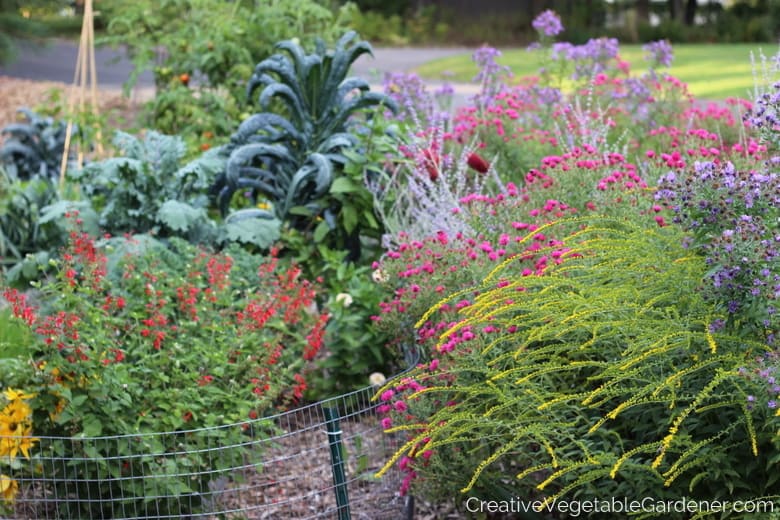
When you think about your perennial flower garden design, are you happy with how it looks?
Do you have continuous color, interesting texture and foliage, and an overall organization of your design?
When looking out your window or sitting in your yard does your garden bring you joy?
As both a vegetable and flower gardener, over the years I’ve designed both kinds of gardens in various yards. And after years of experience, I’ve decided that hands down it’s much harder to create a striking perennial garden than a beautiful vegetable garden.
I’ve redesigned my flower garden multiple times in the past few years – moving and dividing plants, paying attention to bloom times so I know when I have a lull in color, and experimenting with different combinations of plants every year.
It can be a lot of work!
But, over the years I realized I was making one of the most common mistakes of creating a flower garden design – lack of editing!
This realization (and my immediate correction of it!) has resulted in me being able to create a much more beautiful and interesting flower garden.
Unless you’re a professional garden designer, you’re likely making this mistake, too.
In this post, you’ll learn how to avoid a common pitfall when creating a perennial garden and I’ll share some resources to help you craft a flower garden design that more closely matches your vision and delivers lots of impact and color all season long.
My vegetable garden looking tidily mulched in summer!
Weeds! They’re every gardener’s nemesis. And they are, by far, the most common frustration I hear from fellow gardeners. If we’re not careful, weeds can take over our gardens (and our lives!) within a few short weeks of the gardening season.
So, gardener to gardener, I’m here to tell it to you straight. Weeding is a complete waste of time.
And if you’re spending more than a few minutes a week weeding your garden during the season, it’s time to change your strategy.
There’s one simple, inexpensive, and effective tool you can use all season long, year after year, to make your garden weed-less — mulch.
Here’s why vegetable garden mulch is so amazing and how you should use it in your garden.
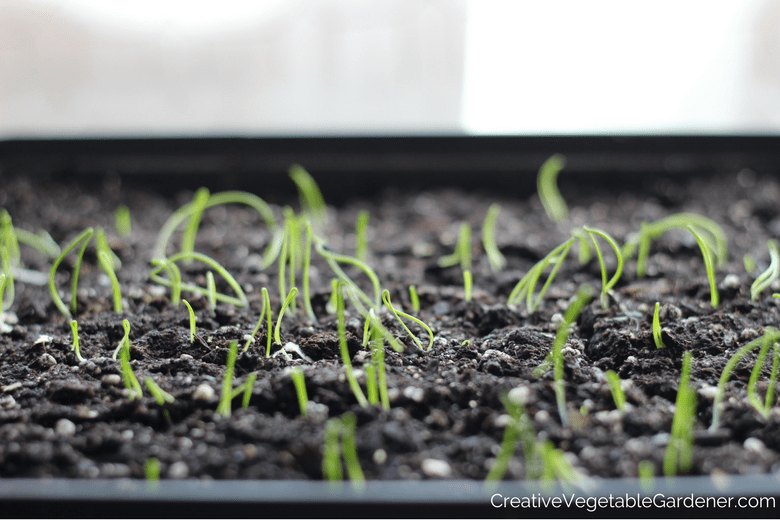
Starting seeds at home can be an extremely exciting and enjoyable part of your gardening experience. After ordering seeds from various catalogues, setting up your seed starting rack and lights, and gathering all of your supplies, it’s time to finally plant.
When you first break open those seeds packets it feels like a miracle to hold tiny, new seeds in your hands. And it’s exciting to imagine the day when they’ll grow big enough to provide you and your family with harvests of beautiful vegetables.
Growing your own food from seed is quite an amazing process!
Unfortunately, it can also be frustrating when you have trouble getting those stubborn seeds to germinate into the plants that will eventually provide you with the food you’re so eagerly anticipating.
If you’ve been foiled by your seeds in the past because you don’t quite understand how to germinate seeds evenly and quickly, I have good news!
There are a few simple tricks you can incorporate into your seed starting process that will help you increase your success rate and avoid seed starting disappointments.
Let’s get started in learning five tips for how to germinate seeds successfully every time.
There are a lot of terms associated with types of vegetable seeds- hybrid, heirloom, open-pollinated, GMO, and organic.
Are you a little fuzzy about what they all mean? As a gardener, it’s important to know what kinds of seeds you’re buying and from whom.
To help you make your own educated decisions, here are a few definitions you’ll want to be familiar with as you dig through your catalogs and go shopping at your local nursery.


 {via http://www.flickr.com/photos/karlgercens}